Categories
Food & Nutrition

Intermittent Fasting: Why I Do It and How I Do It (W)Right

The first time I heard of someone doing this, I thought they were crazy and were going to send themselves into starvation. I mentally judged them, immediately, and came up with a ton snippets of “health tips” that would disprove their practice as fallacy! Ha!

Cut to about 3 months later, when I decided to take a quiz from one of my favorite teaching blogs on all things Metabolism (Read: Fat Loss) related, Metabolic Effect, and guess what this quiz advised me to do? The VERY act that I so ruefully mentally judged others in the fitness industry for doing! Typical, right? (God was listening ;-))

 

Judgey


So now, every day, I don’t eat my first meal until about 11am. I eat my last meal by 7 or 8pm. Basically, I eat in a 8-9 hour window.

WHAT IT IS:
Watch Timing

So, I’m talking about Intermittent Fasting. Let me start by saying that I hate the term “Fasting” because anytime you say that, it makes people think of either a spiritual prayer practice (which is good, but not related), or a detox or cleanse. Which again, those two things can be good for you (if done right), but all these words seem to spark up a lot of “judgey judgertons” just like I admitted to being.

Intermittent Fasting is just a term used to describe going an extended period of time, every day, without eating. We ALL fast every day. This is called sleeping. So, intermittent fasting is a way to just extend the “non-eating” phase of your day because it essentially extends the Fat Burning period of your day.

Studies (and HERE) have actually shown that the TIMING of when we eat can have a bigger impact on our weight that the actual amount of calories we eat! In fact, I talked about this rat study on my blog on NUTRIENT BASED TIMING, HERE. The most recent study published in Cell Metabolism Journal, essentially tested two groups of rats who both ate the exact same amount of calories but one group ate all day long while the other group only at in a 10-12 hour window. The results showed that the group that ate at all hours of the day got obese while the intermittent fasted group of rats stayed at a normal weight. With the exact same amount of food!

The way our fast paced world has been operating lately, we can easily fall into the trap of GRAZING all day, every day. We need a snack at all occasions! I truly believe this contributes heavily (no pun intended) to the deathly serious overweight and obesity epidemic we have on our hands.

WHY I DECIDED TO TRY IT:

So, back to my decision to bite my own judgement and take the advice from the Metabolic Effect quiz I took. First, I have already done a lot of research on the Metabolic Effect website, read their books and know they are Doctors with credentials I trust. This is the most important part about taking advice from any health hack out there (myself included!).

Second, I had already been eating in a 12-hour window for 8+ months at this point. This was something I knew I needed to do not only because I had heard about that rat studies but also just by pure math. I have a large appetite and so if I don’t pay attention to the times and quantities I eat, I can (and have) eaten several hundred more calories than I need to in a day.

Third, the reason why this quiz advised me to push this fasting period back even further is because I had already taken several steps in the (w)right direction for my health and this was just the next best step in the (W)right direction for ME. Meaning, I was already eating a Nutrient-Based diet of clean, holistic foods CONSISTENTLY. While also regularly looking into different meal reviews so I have the option to change my meal plans up a little while still eating the healthy sustenance I need. I has also already practiced short periods of intermittent fasting first before by eating within a 12 and 10-hour window. I was also already active and healthy. I just had stopped seeing results, so it was time to try something new.


HOW IT’S BEEN WORKING SO FAR:

So, I decided this step would be something worth trying to see if it worked for me!

The way to TEST any new dietary change is to monitor 4 areas *H.E.C.D.* (a modified tool from Metabolic Effect as well): 1. Hunger 2. Energy 3. Cravings 4. Digestion. So as I made the change to move my first meal back to 11am and as I ate my meals, I monitored those 4 categories. I told myself I would try it for a full week to let my body adapt and get a real feel for how it was working (or not working).

PROS:
SHOCKING!

-My HUNGER actually went WAY down over the course of the day. I had been used to eating 5-6 meals per day and my body had been conditioned to get hungry when I had been used to eating. So where I thought that I would be building up several more hours of HUNGER from not eating at those times, I was SHOCKED to feel substantially less hungry. I believe this tactic helped to mellow out my hormones (ghrelin and leptin are your hunger and satiety hormones) . I don’t have the exact science as to why, but this is how it turned out for ME.

-Moreover, I actually had less CRAVINGS for sugar and other food items I normally crave as well! My hardest part is still at night more than in the morning, so I do still have a sweet tooth but I manage that with other tools anyway.

-My ENERGY felt about the same! I often found that by overeating so often before, I would put myself into a food-coma and feel lethargic. Now my mornings are my most productive time!

-My DIGESTION is on par. This one relies most on the quality of foods I eat, but going longer between meals helps move things along much better for my body!

On top of all of these factors, the other benefit of doing this is in those months where I was not really being careful about WHAT I ate (I had a ton more sugar, frozen yogurt, and BBQs during the month of July) but I still stuck to this 8-9 hour window, I DID NOT GAIN WEIGHT. At all. So this proves to me that the rat test they conducted is in fact on par with my this human body works too!

Overall, I AM eating enough food (almost the same amount of calories) just in the tighter time-frame. This is VERY IMPORTANT that I’m not starving my body as a crash diet. I am only changing the timing of my eating, not the quantity of food. Since I love big meals, this works great for me too.

CONS:
OCD Coffee

There are a few things I had to adjust and some ways to trouble shoot this that are not the easiest.

  1. I rely more on coffee and caffeine in the AM. I have been getting up by 5-6am to start writing and working, so I’m tired of course, but also that is a pretty long window of being awake without eating. So, coffee (without cream or sugar) and tea are my solutions to keep my stomach calm. If I do experience stomach growls, I’ll drink more water first.
  2. I had to move back my workout time: I was a morning workout girl for a long time but decided that working out fasted is not the smarted idea for me. This worked out though because I needed my mornings for productivity and writing anyway. It will always take an adjustment period to get hyped up enough for an afternoon workout. It also is harder to avoid the excuses of getting “too busy” to go to the gym. Good thing I only do 30-45 min workouts now!
  3. Breakfast is my favorite meal: The absolute hardest thing for me is going out for breakfast with friends and family and not eating. Maybe this is the O.C.D, way TOO self-controlled part of my life, but I am just a person that once I commit to something, I commit to it and stay as consistent as possible. So, when in a situation where we are out to eat or my husband and I are traveling and he is eating breakfast, I will have coffee and enjoy the company and order a meal to go if I have to. I admit this is challenging but only because of the social pressure and because I love breakfast food. Not because I’m hungry, surprisingly.
Give me all the bacon and eggs you have

The (W)Right Way Of Intermittent Fasting:

So, if you are interesting in exploring what this might look like for you, I encourage you to take the following steps:

  1. START 12-HOURS: Start with a 12-hour window of Intermittent Fasting FIRST. This is my Nutrient Based Timing strategy that will work wonders for you if you have not already been eating in this window of time. Stick with this FIRST for about 6-12 weeks. See if you get desired results and good H.E.C.D. results.

  2. SMALL STEPS: If you have already been eating in a 12-hour window, push back your eating window by 2 or 4 hours at the most. You can decide if you want to push back your first meal of the day, or stop eating earlier in the evening. Pay attention to the clock and adjust it if necessary according to your plans that day (dinner out, etc).

  3. STAY CONSISTENT: I don’t advise doing just one day here or there of intermittent fasting. I think this is how you start to confuse your hormones and metabolism into thinking you are indeed ‘starving’ on certain days. If your body thinks your starving, it will go into shut-down mode and slow your metabolism. No bueno.

  4. SATISFY YOUR BELLY: Eat well and eat enough! For the above reason, you should make sure you are eating enough food! You reasonably can have 3 solid meals and maybe one snack all within that 8-9 hour window. Eating causes a BOOST in your metabolism because you have to burn calories to digest. So a large BOOST followed by an EXTENDED FAST (Fat-Burning) period is why this science works.

  5. STAY TRUE TO YOU: If your H.E.C.D. is all off after trying this, then I don’t think intermittent fasting is for you and your body type. Some people with higher metabolisms will just have a harder time with this because their bodies need more energy more often. This is GREAT to learn and important for you to listen to! I think intermittent fasting works for me because I have a endomorphic/mesomorphic body type. (More on this another time!).

I’d love to hear your thoughts and/or experiences you have encountered with intermittent fasting! Every body is different and I’d like to hear what you like, didn’t like or if you are going to give it try and why!

 

Categories
Fitness & Training Food & Nutrition Uncategorized

Nutrient Based Timing! WHEN you eat can be as important as WHAT you eat!

Part II of my quest to create a Nutrient-Based society is taking a look at the timing of eating, especially when eating Nutrient-Based!

Just as a recap from Part 1 that I’ve been featuring over the course of the last couple of weeks (HERE) the importance of having a Nutrient focus with each of your meals will help ensure that you get enough of the necessary vitamins and minerals!    

Vitamins and Minerals are absolutely necessary to not just look better (brighter skin, acne control, stronger bones and teeth, muscle tone, etc.) but to also feel better (high energy, low fatigue, efficient digestion, internal organs all doing their job, better sleep, disease prevention and high immunity, etc.)

But, as you might have guessed, just being sure you are getting enough of the necessary vitamins and minerals does NOT necessarily mean that you are able to stay lean and fit! 

Quality of food IS an incredibly important step in the right direction, but it does not necessarily promote weight loss or physique goals!

So, the next part I want to introduce to the Nutrient Based Diet is the TIMING of when you eat.

While there are no rules  to Finding “A. Wright Fit” for yourself, I have found that there are definitely some benefits to monitoring your eating patterns and adjusting how often you eat!

It all boils down to just 3-Steps to Nutrient Based Timing! 

(click picture to view more clearly)

Nutrient Based Timing INFOGRAPHIC

(If you’re interested in getting this printable infographic for you to add to the 5-Steps of the Nutrient Based Eating that you can get by signing up HERE). 

Step 1: Go minimum 12-hours without eating every night.

Research has been showing more concretely lately that going extended periods of time in a “fasted” state at night, has been extremely effective in helping bodies avoid obesity, even when eating a high fat diet.  It has been termed Intermittent Fasting in the fitness community.

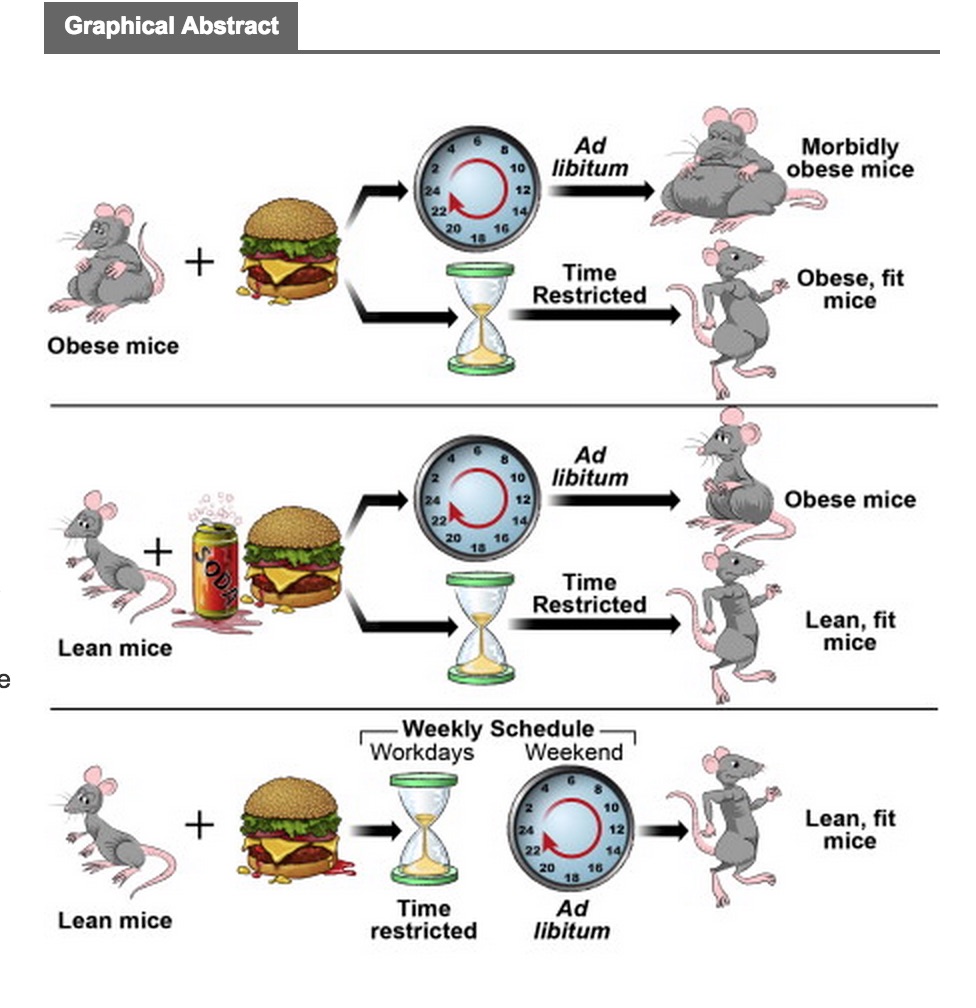
The concept of intermittent fasting was first introduced around 2009 and was popularized with a study that occurred in 2012. In this rodent research, three groups of mice were studied.  One group was fed healthy food and the two others were fed the the same “higher fat” diet.  Of the high-fat diet, one group was allowed to eat at all times of the day (“ad libitum”) and the other group was restricted to eating only 8-hours of the most active part of their day.  The group that actually restricted their diet to just the 8-hours of the day stayed just as lean as the group that ate “healthy” food.  But the group that ate the same amount of calories and food, but ate at all hours of the day, became obese!!   Read about this study HERE.

Even more recently, another follow-up study has been done over a less drastic fasting time range that has equally shown great results.  This study had 4 groups of mice fed differing diets and found that over a 38-week study, the mice that limited their food intake to just 9-12 hours of the day, were able to stay lean and fit no matter what diet they were given.  More importantly, the study also tested whether those same mice could take a “break on the weekend” (much like we humans do)  and indeed, they were still able to stay fit and trim mice even when taking those weekend breaks in fasting.    Here is the graphic from the study and link HERE.

Intermittent Fasting Mice Graphic www.cell.com

I have personally tried intermittent fasting both for the 8-hour eating window AND a 12-hour eating window and I find that both time frames work equally well to one another for my body. 

The difference I have found is that I’m much more uncomfortable when trying to go 16-hours a day fasted.  I have early morning stomach grumbles like crazy and I would rely more heavily on coffee and tea in the morning (without cream or sugar, or it doesn’t count!) which I found unsustainable for my lifestyle.

Now that I only eat 12-hours a day (and thereby fast for 12-hours a day), I find it much easier to implement  this into my lifestyle and now many of my clients too!

This is how it works:

If you finish your last meal by 8pm at night, then you simply drink water, plain coffee or plain tea in the morning until your first meal at 8am.

For those that are morning people, you may want to monitor your dinner the night before so you can have the breakfast you need at the time that more convenient. 

For those that are night owls, you might do just fine eating a little later of a dinner since you’ll be up later at night.   (See more about food timing after STEP #3 below)

Step 2:   Eat meals every 3-4 hours, with no snacking in between!

We live in a society where we have immediate access to food.  What a blessing that is! 

But with such access comes the unfortunate tendency to snack or “graze” all day long.  I call it “Drive by Eating” in my home.  Every time I come across the nuts in the pantry, I gotta munch on a few!   Every time I open the refrigerator for some water, I see the grapes and I gotta pop a few into my mouth! It is mindless and I’ve had to put some parameters on myself in an effort to stop!

Some of us have heard that we need to eat “every 2 hours” when trying to lose weight to “speed up our metabolism.”  But recent studies have actually debunked that myth.

The reality is that it all depends on your body and how fast your digest and break down your food.  It also depends on the size of your meal (which we’ll get to in Part III of the Nutrient-Based living!).   

So some bodies WILL eat 5-6 meals per day because they will digest their food fast enough.  But more commonly, most of us will eat 4 meals a day, which allows adequate time in between meals.

A list of benefits for allowing more time between meals is:

  • You are more likely to eat when you’re body is actually hungry, not just when you’re craving something. 
  • You give your digestive system adequate time to reset its digestive hormones and secretions necessary for adequate and efficient food break down.
  • The digestive rest in between meals is reseting your fat metabolism (i.e. You are in Fat Burning Mode!)
  • It helps regulate your hunger and satiety hormones (Ghrelin and Leptin, respectively)
  • Helps you maintain normal blood sugar and insulin responses. 
  • Helps maintain balanced mood.
  • Allows your body to use energy toward detoxing your systems instead of only focusing on digesting.

The amount of time you need to wait in between meals is unique to your body.  Since you are eating a full, Nutrient-Based meal for every meal, the size of this meal should take at least 3 hours to fully digest, if not more.  The fiber, the protein and the fat in our meals do take a while to break down. 

Some of you might have much faster metabolisms which means your body will become physically hungry much sooner. 

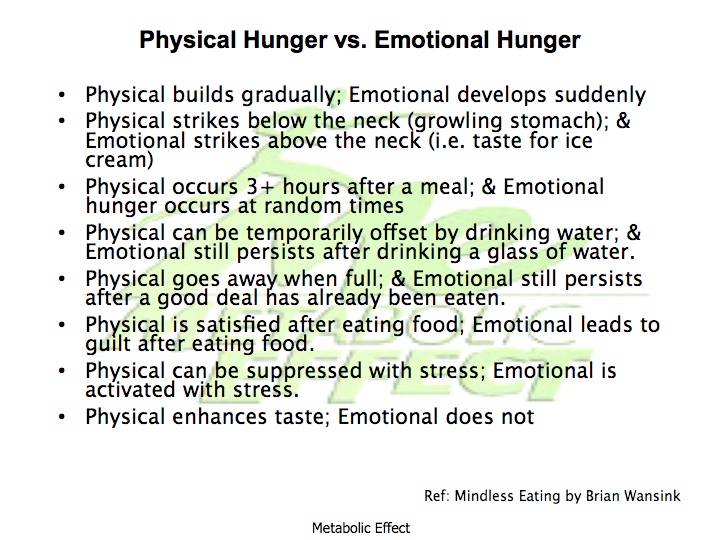
I encourage everyone to determine signs that you are “physically hungry” versus when you are mentally or emotionally craving something.    Here is a graphic from Metabolic Effect that I think sums it up really well!

Physical Hunger Verus Emotional Hunger Graphic

To ward off the tendency to have high cravings or emotionally eat in between meals, drinking water or herbal and green tea (without sugar or cream!) is really helpful in keeping your stomach happy and your body circulating!

STEP 3:  ATTEMPT TO EAT AT THE SAME TIMES EVERY DAY

The reason for trying to time your life to be similar day to day is because of the value add of going along with your Circadian Rhythms.  To get to the point, many functions in our body is regulated best in a rhythm, including when we eat!


To optimize these rhythms, the goal is to eat around the same time every day!  Your role for your body is to asses and see what times of day work best for you!

Circadian Rhythms are defined as: “physical, mental and behavioral changes that follow a roughly 24-hour cycle, responding primarily to light and darkness in an organism’s environment.” (National Institute of General Medical Sciences)

Essentially, it is our internal, or “body clock”, that regulates our hormonal responses, body temperature, heart rate and sleep cycles

Circadian Rhythms (CR) certainly contribute largely to our sleep/wake patterns in our life since they are highly regulated by the light and dark responses. 

But studies have shown that they can also be regulated by the timing of eating!  Eating at times when our bodies are in “rhythm” to eat is ideal for metabolic responses to be at their best. 

Our CR is mainly regulated by an area in our brain, the Hypothalamus, where about 20,000 neurons called the SCN (Superchiasmatic Nucleus) as the “master clock.”  But, recent studies have shown that the expression of our bodies “clocks” are not limited to just that area of the brain, but have been found in many tissues and cells throughout the body called the “peripheral tissues.”

Several studies  reported on in The-Scientist Journal HERE said:

“From these studies it’s clear that the clocks in peripheral tissues—vulnerable as they are to the timing of eating—are vital to metabolism in the body’s organs. “I would say the clock is playing a very fundamental role regulating all metabolic pathways,” says Takahashi, “not just in organ systems, but at a cellular level.”

Finding a patterned rhythm of eating that best supports your metabolism is one of the best things you can do to promote your healthiest, most energy efficient, and LEAN bodies possible!  

Sporadic eating does not contribute to helping find the natural “rhythm” of your body.  It causes some disruption to these natural rhythms and causes more internal stress than you know.   

In reality, we all know that we don’t always eat just when our bodies are hungry.  That would be too easy!

We eat largely because of behavioral and mental reasons too: 

  • -We eat just because it’s 12-Noon and we think “oh, I must have lunch!”. 
  • -We eat because we schedule that dinner with the couple at that certain time. 
  • -We eat because everyone else around us is eating.  We eat because we’re bored or sad or happy.

Just becoming more aware of an eating pattern (and sleep and wake pattern too!) is a great first step in finding your best rhythm for your energy!

WHAT TO DO:

  1. Map out your typical schedule.
  2. Start with the time you’d like to wake-up and the time you need to go to bed (getting 7-9 hours of sleep).
  3. Start with those personal qualities that are important to your eating life and require priority in planning.

—Do you workout early in the morning or evening?
—Does your family stress the importance of family dinners?
—Do you have a designated lunch hour that you need to stay within?
—Are there times of the day that you are most active and therefore most hungry afterward?
-If there is a particular meal time that you know you already are akin to, start THERE.  Don’t try to force something different from that important spot.

4.  From that time, designate a meal 3 hours before and 3 hours after (as many times as necessary) until you get about 4-5 meals. Some meals will be bigger some may be smaller.

5.  Assess and be sure that you are able to implement the 12-hour window of Step #1 given this timeline and map.

Allow me to use myself as an example:

*Everyday, I get up at 530am and go to sleep at 9pm-930pm.
*My main meal priority is my workout, which I typically do at 10am.  Therefore, my priority meal is right after this at 11am.

My schedule thus becomes:

Meal #1- 8am breakfast
Meal #2- 11am post workout
Meal #3- 2pm
Meal #4- 5/6 pm Dinner
(Meal #5- 8pm Post dinner snack (if I need it))

IF, I need to change my workout that day, I  still don’t change my meal timing.  I try to fit in the workout in a way that will allow be time to keep this schedule (so I’d try to workout at 12/1pm, or 4pm).

REMINDER!!!

As with all things about your body, this is an investment in time and requires patience for you to learn about YOU!  What works for me, may not work for you.  What works for you may not work for your sister!

But the payoff to some true, intentional investigation into your body, will be tremendous!  Remember, you are not put on this earth just to look a certain way!  You are put here for a GREATER PURPOSE!  Your LIFE must be LIVED in order to fulfill that!  Taking care of your health in your responsibility and the gift that you give back to God for the amazing, although at times HARD, life you have been given!

Your hard work will pay off in ways you can’t even imagine!  Just take it 1… 2…or  3 steps at a time!

Have any questions?  Comment below or contact me at amanda@amandawrightfit.com!