I have to say, I’m a little fascinated with Japan and now I have reason to be even more so. I have been so lucky to have been able to travel there 4 times so far since my stepdaughter lives there right now, stationed with her mom and her stepdad in the navy.
Every time we travel to Tokyo and the surrounding cities, I am in awe of the culture. They are very clean people (I once saw a man who’s sole job was the clean the grates and cracks of the metal part you step on right before hopping on a escalator), they are incredibly gracious people (bowing to you every time you enter their store and when you leave it), and they are very healthy people (ranked 5th on Bloomberg’s list of healthiest nations in 2015—the US was ranked 33rd, btw).
It was of no surprise that when I was researching the BEST and most foundational habits to build in your nutrition (as is covered in my soon to be released Nutrient Based Eating book), one of the best practices for eating in moderation originated in a Japanese province.
Okinawa, Japan is considered one of the coveted “Blue Zone” areas of the world which are those cities that have a high population of Centenarians, or those people who live over the age of 100. Naturally, these populations of people cause us to look deeper into their nutrition habits and cultures to speculate what their longevity and health secrets are.
While there are some surprises we find from this population, such as while they are Japanese residents, they actually don’t eat as much fish as we would expect. Their eating is largely centered around plant-based eating and holistic food choices.
But, what is truly impactful to their longevity is the principle called “Hara Hachi Bu” (or Hara Hachi Bun Me) which means “eat until your belly is 80% full.”
It is the mindful approach to portion control and calorie restriction which has lead to an extended life and a higher quality life in older age.
According to the Wikipedia page, it is believed that the average Okinawan resident eats only between 1,800-1,900 calories per day. Whereas another study showed that the US, (once again not to be outdone!), ranked #1 with the most calories consumed per day with an average of 3,770!
So, while there will be a time and place to address WHAT you’re eating, one solid habit to form is simply HOW you’re eating.
This habit of avoiding overeating will be invaluable to your long term health and pave the way for you to be able to enjoy the foods you like the most, simply in moderation.
Can you learn to stop eating at 80% full? Yes, I know you can. Here are some mindful eating tips to help you.
1. Remember, like all habits, this will take about 63 days to form, so focus on it by itself.
Dr. Caroline Leaf and associated neuroscientists have proven that while a memory takes 21-days to form, an actual habit of automated behavior takes 63 days.
So, you need to go into the habit fully expecting the daily practice sessions to be long and bumpy. The thing about this habit is it requires several cues that we so easily forget to do simply because of the pace in which our life. So while it is technically one habit of registering fullness and stopping eating, it will involve several other behavioral habits that are the remainder of this list.
This is why, in my Nutrient Based Eating program I have all clients focus on just ONE nutritional habit at a time. Trying to achieve this while simultaneously working on food choices, eliminating food groups etc, is simply too overwhelming for our brain to handle. With this one, give yourself 2 solid months of discipline and diligence!
2. Stop Multitasking Eating
Now, I get it. With all the things you have going on in your busy life, you sometimes think the only time you can squeeze in remembering to eat might be at your office while you're fielding emails or scarfing on a snack while you’re driving, but the reality is that these behaviors are not just bad for the cause of overeating, but also for digestion and drawing out the vitamins and minerals from your foods.
Remember, while food is certainly enjoyable, it’s also designed to help fuel your body and a very important aspect of that is digestion! When you are eating too fast and eating on the run, your body does not digest the foods as well and you are robbed of some of the necessary vitamins and minerals you need! The stress levels of a hurried lifestyle impact far more than you’ve bargained for. So pencil in your meal times without any distractors! Give yourself 15-20 mins to eat!
3. Practice Registering Hunger/Satiety Cues:
On a previous blog, I went over the difference between hunger and cravings and the importance of eating when you’re about a level 7 on a scale of 1-10 of the hunger scale. Equally important is knowing your satiety scale as well. In this case, you will want to stop eating at a level 4-5 of the hunger scale and note that it will take your body 15-20 mins to fully register fullness (hormonally).
Here’s how I would characterize each level from 1-10.
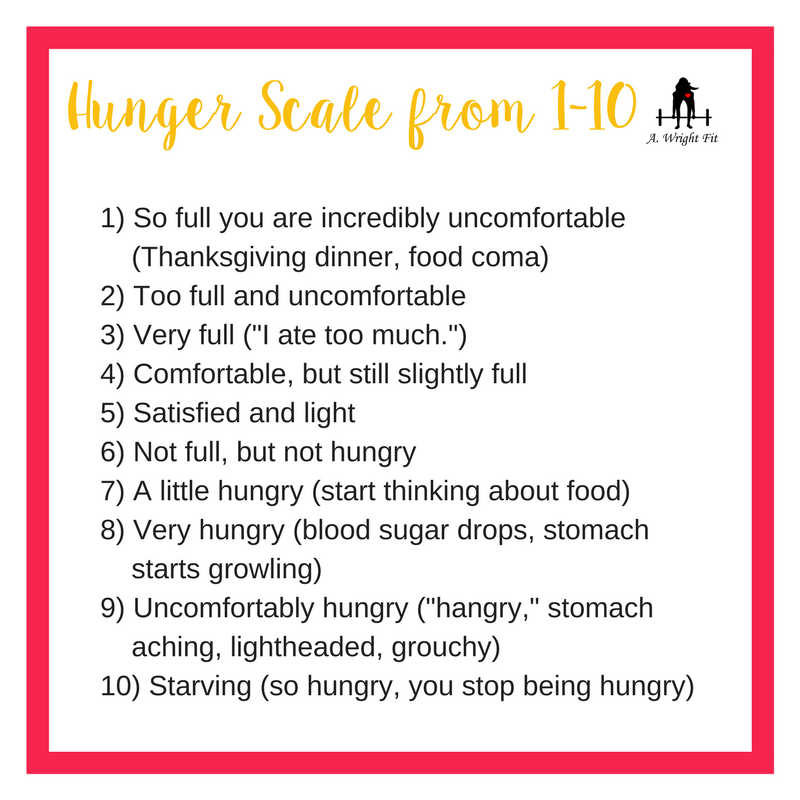
*Note: When you stop eating at a level 4-5 you may also need to pay attention to eating sooner than you normally would as well. If you normally eat so much lunch you go until dinner without anything in between, it’s wise to pack a snack and expect to get your hunger back on track to eating every 3-5 hours.